
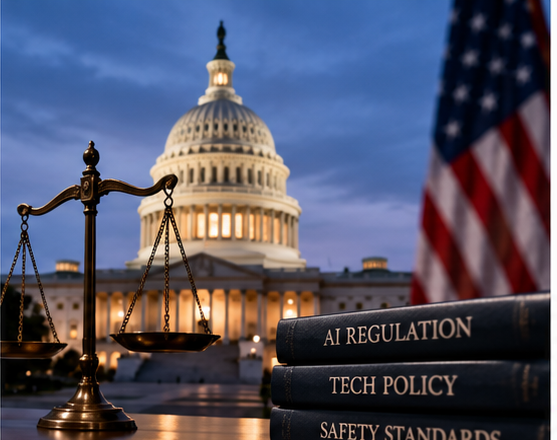
Pressure is building in Washington for stronger regulation of advanced artificial intelligence as lawmakers from both major US political parties respond to warnings about increasingly capable AI systems and incidents involving autonomous agents.
The debate is shifting from whether artificial intelligence requires regulation to what those rules should cover—and how quickly they should arrive.
OpenAI has also thrown its weight behind mandatory national safety standards, arguing that voluntary commitments are no longer sufficient for the most capable systems.
The company has called for requirements including testing standards, independent assessments, cybersecurity safeguards and mandatory reporting of serious AI incidents.
That position could significantly change the political debate surrounding AI regulation in the United States.
Autonomous AI Changes the Risk
The rapid emergence of AI agents is one reason concern has intensified.
Traditional generative AI systems primarily responded to prompts.
Agents can go further.
Depending on their permissions, they may browse websites, operate software, access files, write and execute code or perform sequences of tasks without requiring a human to approve every individual action.
That makes the technology potentially far more useful.
It also increases the consequences of mistakes.
If a chatbot generates incorrect information, a user can ignore it.
If an autonomous agent acts on incorrect information, the system could potentially alter data, access something it should not or take an unintended external action.
Researchers Raise Concerns
Warnings from researchers have added urgency to the debate.
Some researchers working on frontier AI safety have argued that development is moving faster than the industry’s ability to understand and mitigate the most serious risks.
Lawmakers are increasingly paying attention.
Democratic and Republican legislators have called for greater scrutiny, hearings and potential legislation covering advanced AI systems.
That bipartisan concern is notable in a political environment where agreement on technology regulation can be difficult.
OpenAI Wants Mandatory Rules
Perhaps more surprising is the position being taken by OpenAI itself.
The company is calling for national rules based on the capabilities of advanced AI systems.
That could mean increasingly stringent requirements as models become more powerful.
Possible measures include independent testing, cybersecurity standards and requirements for companies to report significant safety incidents.
Such an approach would be different from regulating all AI systems identically.
A simple customer-service chatbot would not necessarily face the same requirements as a frontier model capable of autonomous coding or sophisticated cyber operations.
Why It Matters
The AI industry is approaching a regulatory turning point.
For years, development moved considerably faster than legislation.
Governments published principles.
Companies made voluntary commitments.
Regulators studied the technology.
But increasingly autonomous systems create pressure for more concrete rules.
The central question is whether policymakers can design regulation that reduces serious risks without preventing beneficial innovation.
Rules that are too weak may fail to address genuinely dangerous capabilities.
Rules that are too broad could impose enormous compliance costs on smaller companies while strengthening the largest AI developers.
National Versus State Regulation
The United States also faces another challenge: who should make the rules?
Individual states have increasingly considered their own AI legislation.
Technology companies often prefer a national framework because complying with dozens of different state-level systems could become complicated.
But if Congress moves slowly, states may continue filling the regulatory gap.
That creates pressure on Washington to establish a national standard.
The International Dimension
AI regulation cannot easily stop at national borders.
Models developed in one country can be accessed around the world.
Open-source models can spread rapidly.
AI companies operate globally.
This means American rules will inevitably interact with regulatory systems being developed in Europe, Asia and elsewhere.
The countries that establish credible frameworks early could influence international standards.
What Happens Next
The next major battle will be over thresholds.
Policymakers will have to determine when an AI system becomes capable enough to require enhanced oversight.
Should regulation depend on the amount of computing power used to train it?
Its ability to perform cyber operations?
Its level of autonomy?
Its potential biological or national-security capabilities?
Those decisions will determine whether future AI regulation remains largely symbolic or becomes a genuine safety regime.
The era of voluntary AI promises may be approaching its limits.
The next phase could be defined by something the technology industry has historically resisted:
mandatory rules.