
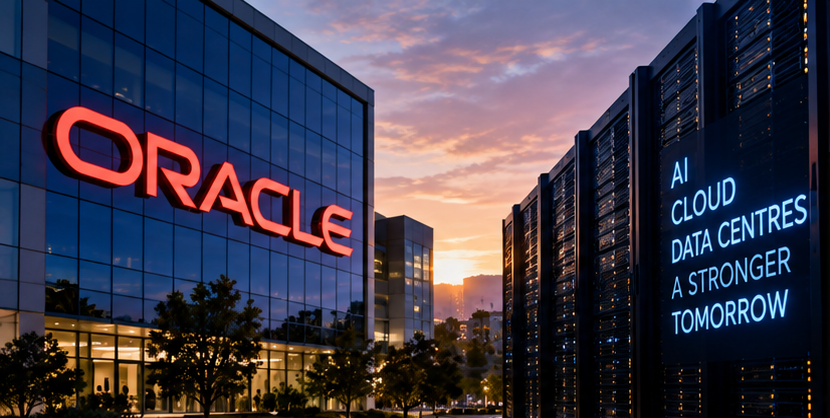
Oracle’s aggressive push into artificial intelligence infrastructure is delivering stronger growth, with quarterly revenue climbing 30% as demand for cloud computing capacity continues to accelerate.
The technology company reported revenue of $19.3 billion for its first fiscal quarter, beating analysts’ average estimate of about $19.14 billion.
More striking was the amount of business Oracle has already contracted but has yet to recognise as revenue.
Its revenue backlog reached $664 billion at the end of the quarter, up from $638 billion three months earlier and ahead of market expectations.
Oracle shares rose nearly 7% in extended trading following the results.
But behind those headline numbers sits another figure that reveals the extraordinary economics of the artificial intelligence boom.
Oracle spent $28.5 billion on capital expenditure during the quarter.
Oracle Is Becoming an AI Infrastructure Company
Oracle built its reputation primarily through database software.
Cloud computing has been changing that identity for years, but artificial intelligence is accelerating the transformation.
Companies developing and deploying AI systems require enormous amounts of computing capacity.
That means processors.
Servers.
Networking.
Storage.
Cooling.
Electricity.
And data centres capable of bringing everything together.
Oracle is attempting to become one of the major providers of that infrastructure alongside Amazon Web Services, Microsoft Azure and Google Cloud.
The company brought another 850 megawatts of capacity online during the June-to-August quarter as it expanded its data-centre footprint.
That scale of construction helps explain why expenditure has risen so dramatically.
$664bn Backlog Changes the Story
Oracle’s enormous revenue backlog is particularly important.
Backlog represents contracted business that has not yet been recognised as revenue.
It therefore provides investors with some visibility into future demand.
At $664 billion, Oracle is sitting on a huge pipeline of contracted revenue.
The challenge is converting those commitments into actual sales without destroying cash flow in the process.
Building data centres before customers can use them requires enormous upfront investment.
Oracle’s finance chief, Hilary Maxson, said much of the newly contracted revenue will not require Oracle itself to purchase additional chips because customers are increasingly using mechanisms such as prepayment or bringing their own hardware.
If that approach expands, Oracle may be able to grow infrastructure revenue without funding every component itself.
The Spending Is Enormous
Capital expenditure of $28.5 billion during a single quarter illustrates how dramatically the economics of large technology companies are changing.
Oracle’s net cash outlay was around $18 billion.
Analysts had expected considerably less capital spending.
Investors have consequently become increasingly concerned about cash flow.
S&P Global downgraded Oracle’s credit rating in July, citing weaker cash flow and growing business risks.
Oracle’s challenge is straightforward.
AI customers want enormous amounts of computing capacity now.
Building that capacity requires spending money before much of the associated revenue arrives.
Stargate Adds Another Dimension
Oracle is also closely associated with the Stargate AI infrastructure initiative.
The project reflects the extraordinary scale at which the technology industry now thinks about artificial intelligence infrastructure.
But large data-centre projects face constraints that cannot be solved with software.
Land has to be secured.
Power must be available.
Construction workers are required.
Permits need approval.
Advanced chips must be delivered.
Transmission infrastructure may need upgrading.
Reports of delays connected with labour, permitting and power availability have therefore attracted investor attention.
They also illustrate an increasingly important reality about AI.
The industry’s biggest bottlenecks are becoming physical.
Why It Matters
Oracle’s results demonstrate that demand for AI computing is not merely benefiting companies that develop artificial intelligence models.
An enormous secondary economy is forming around those models.
Cloud providers supply computing.
Semiconductor companies supply processors.
Memory manufacturers supply HBM.
Networking companies connect the systems.
Utilities supply electricity.
Construction companies build the facilities.
AI is increasingly becoming an infrastructure investment cycle.
Oracle wants to occupy one of the most valuable positions in that ecosystem.
Investors Want Returns
The difficult question is whether AI revenue can grow quickly enough to justify the expenditure.
Oracle expects at least $90 billion in fiscal 2027 revenue and has raised its adjusted annual earnings forecast.
For its second quarter, the company expects revenue growth of between 30% and 34%.
Those are impressive growth rates for a company of Oracle’s size.
But the market is no longer judging AI investment solely by revenue growth.
Investors increasingly want to understand the return generated by every dollar spent on infrastructure.
The Bigger Picture
The cloud industry’s competitive advantage used to depend heavily on software, developer ecosystems and global availability.
AI adds another requirement:
capital.
Companies must be capable of financing increasingly expensive computing infrastructure.
That could ultimately favour technology giants with enormous balance sheets and access to global debt markets.
It may also reshape Oracle itself.
The company that became famous for databases is increasingly competing as something much larger:
an operator of the industrial infrastructure behind artificial intelligence.
What Happens Next
Oracle now has to demonstrate that its $664 billion backlog can translate into sustained revenue and eventually stronger cash generation.
Investors will also watch capital expenditure, data-centre construction and the progress of major AI infrastructure contracts.
The opportunity is enormous.
So is the bill.
The defining question for Oracle—and increasingly every hyperscaler—is no longer whether companies want AI computing.
They clearly do.
It is how much money must be spent before the AI infrastructure boom becomes sustainably profitable.