
For years, the data centre was largely invisible to the average internet user.
It sat behind cloud storage, streaming services, social networks, online banking and countless applications, quietly processing information whenever someone clicked a button or opened an app.
Artificial intelligence is transforming that infrastructure.
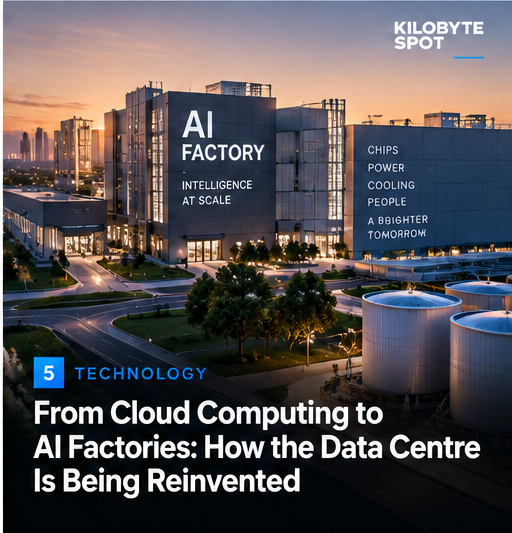
The industry has increasingly adopted a new term for some of its most advanced facilities:
AI factories.
It is partly marketing language, but it also reflects a genuine change in how large computing facilities are being designed and measured.
Traditional cloud data centres were built to run an enormous variety of applications.
AI infrastructure is increasingly being engineered around one core objective:
Producing intelligence at massive scale.
What Is an AI Factory?
The factory analogy comes from treating AI output almost like an industrial product.
A conventional factory takes raw materials and converts them into physical goods.
An AI factory takes data, electricity and computing resources and converts them into model training and, increasingly, tokens—the pieces of information generated and processed by modern AI systems.
That changes how infrastructure performance is measured.
For conventional computing, operators may focus heavily on processor utilisation, storage capacity and network availability.
AI infrastructure introduces metrics such as:
Tokens per second
Tokens per watt
Cost per token
Time to train
Inference latency
When millions of users interact with AI systems continuously, small improvements in these measurements can translate into enormous financial differences.
Everything Has to Work Together
AI computing also requires much tighter coordination between components.
A powerful accelerator is only useful if memory can feed it information quickly enough.
Thousands of accelerators only deliver their full performance if networking equipment can move data efficiently between them.
The servers cannot operate without enormous amounts of electricity.
And all that electricity eventually becomes heat that must be removed.
That means an AI factory increasingly has to be designed as one integrated machine.
Processors.
Memory.
Networking.
Storage.
Cooling.
Power distribution.
Software.
Even the building itself.
The Rack Is Becoming the Computer
Earlier generations of computing often focused on individual servers.
AI infrastructure increasingly operates at rack scale.
Dozens of processors can be connected together so tightly that the overall system behaves more like a single enormous computer.
Scale that across rows of racks and eventually entire facilities, and the architecture begins to resemble a giant computing engine.
Nvidia’s current AI-factory strategy illustrates this shift.
Its reference architectures combine accelerated computing, high-speed networking, software, storage integrations and increasingly even power-delivery designs.
The company describes AI factories as systems integrating energy, chips, infrastructure, models and applications.
Power Changes Everything
Perhaps the most important difference between cloud infrastructure and the emerging AI-factory era is electricity.
AI racks can require extraordinary amounts of power.
As density rises, conventional data-centre electrical systems face new challenges.
Nvidia, for example, is promoting an 800-volt direct-current architecture for next-generation AI infrastructure, arguing that older approaches to distributing power become inefficient as computing density increases.
This is a reminder that some of the hardest problems in artificial intelligence are no longer purely digital.
They are electrical and mechanical engineering problems.
Cooling Becomes Strategic
More computing power creates more heat.
Traditional data centres relied heavily on air cooling.
Increasingly dense AI systems are pushing operators toward liquid cooling, where fluids transfer heat away from processors more efficiently.
That changes facility design.
Pipes, pumps, heat exchangers and water systems become part of the computing architecture.
The distinction between a technology facility and an industrial facility starts to blur.
Why It Matters
The AI-factory transition could reshape large parts of the technology industry.
Semiconductor companies benefit from demand for accelerators.
Memory manufacturers supply high-bandwidth memory.
Networking companies connect processors.
Power-equipment manufacturers supply electrical infrastructure.
Cooling specialists manage heat.
Utilities provide electricity.
Construction companies build enormous facilities.
Cloud providers operate them.
AI companies consume their computing output.
The artificial intelligence economy therefore extends far beyond the companies developing models.
There Is an Economic Question Too
The enormous cost of AI infrastructure creates pressure to keep expensive equipment working as efficiently as possible.
A GPU sitting idle inside a billion-dollar computing facility represents wasted capital.
This is why utilisation and cost per token matter.
Technology companies are trying to produce more AI output from every dollar invested and every watt consumed.
The companies that succeed may be able to offer AI services more cheaply—or operate them more profitably.
The Bigger Picture
Cloud computing transformed technology by allowing businesses to rent computing resources instead of owning their own servers.
AI factories represent a different transition.
Computing infrastructure is becoming specialised around producing artificial intelligence continuously and at enormous scale.
That could eventually create a new industrial layer of the global economy.
Data centres will increasingly compete for land.
Electricity.
Water.
Chips.
Memory.
Engineering talent.
And access to power grids.
The physical geography of computing may become strategically important again.
What Happens Next
The next generation of AI infrastructure is likely to become larger, denser and more tightly integrated.
Technology companies are already planning facilities with power requirements measured on scales once associated primarily with industrial plants.
At the same time, pressure will increase to make those facilities more energy efficient.
The data centre isn’t disappearing.
It is evolving into something substantially more specialised.
The cloud era taught the world to think of computing as a service available almost anywhere.
The AI era is reminding us that behind that service sits something extremely physical:
chips, cables, cooling systems, buildings—and enormous amounts of electricity.