
For decades, workplace software has largely waited for humans to tell it exactly what to do.
Employees wrote documents, built spreadsheets, searched emails, prepared presentations and moved information between applications.
Artificial intelligence is beginning to challenge that model.
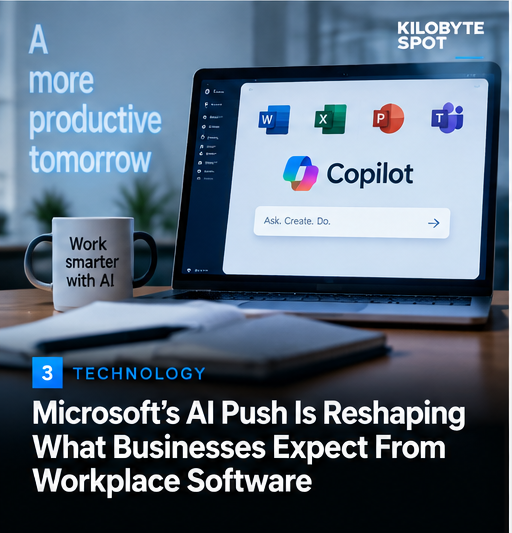
Microsoft’s expanding Copilot strategy is pushing productivity software toward a world where applications do more than provide tools. Increasingly, they are being designed to understand an objective, find relevant information and perform parts of the work themselves.
The shift could fundamentally change what businesses expect from software.
From Copilots to Coworkers
The first generation of generative AI workplace products largely operated as assistants.
Ask a question.
Summarise a document.
Rewrite an email.
Generate a presentation.
The emerging generation of AI agents is designed to go further.
Instead of responding to a single instruction, agents can potentially complete sequences of tasks involving multiple documents, applications and sources of information.
Microsoft’s Copilot Cowork is one example.
The company made the product generally available in June after a preview period, saying more than half of Fortune 500 companies had already been using it.
Microsoft has highlighted examples including comparing thousands of files across different product versions and analysing sales pipelines to identify opportunities at risk.
That represents a different relationship between employee and software.
Instead of asking:
“Help me analyse this spreadsheet.”
A worker increasingly might say:
“Find the problems in this project and prepare what I need for tomorrow’s meeting.”
The software then determines some of the steps required.
The Interface Is Changing
For decades, workplace computing revolved around applications.
You opened Word to write.
Excel to calculate.
PowerPoint to present.
Outlook to communicate.
The rise of AI agents could weaken those boundaries.
A user may increasingly interact with an AI layer capable of accessing several applications simultaneously.
The underlying applications will still matter, but users may spend less time navigating them manually.
This could eventually make the AI assistant itself the primary interface to workplace computing.
Why Businesses Care
The attraction is straightforward: time.
Many employees spend significant portions of their working day searching for information, formatting documents, updating spreadsheets, organising communications and moving data between systems.
If AI agents can reliably automate parts of that work, companies could increase productivity without requiring employees to master increasingly complicated software.
But reliability is crucial.
A chatbot producing an incorrect answer is inconvenient.
An autonomous workplace agent incorrectly modifying a financial spreadsheet, sending information to the wrong person or making a decision based on incomplete data can create considerably greater problems.
That means enterprise AI will increasingly depend on permissions, audit trails, security and human oversight.
The Software Business Could Change Too
AI agents also create an important question for the software industry itself.
If workers interact primarily through an AI assistant, individual applications could become less visible.
Imagine asking an agent to:
Analyse customer feedback.
Update a financial model.
Prepare a presentation.
Schedule a meeting.
Send the summary.
Today, those tasks might involve several different applications.
Tomorrow, the user may only interact with the agent.
That could change how software companies compete.
The most valuable product may no longer be the application with the largest collection of features.
It could be the platform whose AI understands a company’s data and can safely take action across its systems.
Microsoft Has an Important Advantage
Microsoft already occupies a powerful position in workplace technology.
Microsoft 365 provides the company with access—subject to organisational permissions and controls—to the applications where many employees create documents, communicate and collaborate.
That makes AI integration particularly significant.
An AI assistant becomes considerably more useful when it can work with the documents, messages, calendars and spreadsheets employees already use.
Microsoft is also continuing to expand the models available through Copilot, reflecting a broader shift toward AI platforms that can draw on multiple model providers rather than relying on a single system.
The Bigger Picture
The transition resembles earlier changes in computing interfaces.
Command lines gave way to graphical interfaces.
Desktop software increasingly moved into browsers and cloud services.
Smartphones shifted computing toward apps and touchscreens.
AI agents may represent another interface transition.
Instead of learning where a function exists, users increasingly describe the outcome they want.
Software figures out how to achieve it.
That is a profound change—but only if the systems become reliable enough to earn users’ trust.
What Happens Next
The next phase of workplace AI will therefore be determined less by whether models can generate impressive text and more by whether agents can consistently complete real work.
Companies will evaluate whether the technology reduces costs, saves employees time and integrates safely with existing systems.
Workers, meanwhile, will have to learn a different skill.
Instead of simply knowing how to operate software, they may increasingly need to know how to delegate work to it.