
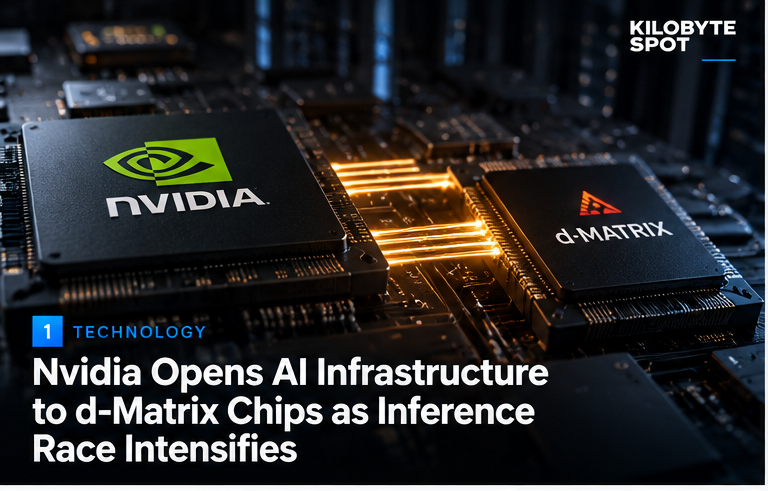
Nvidia is expanding the reach of its artificial intelligence infrastructure beyond its own processors, with chip startup d-Matrix set to connect its next-generation AI chips directly into Nvidia-powered data-centre systems.
The agreement represents another step in Nvidia’s effort to make its technology a foundation for a broader ecosystem of AI processors, even as competitors attempt to capture parts of a market the company has dominated.
d-Matrix plans to use Nvidia’s NVLink Fusion technology with its forthcoming Raptor processors, which are designed primarily for AI inference—the process of running trained artificial intelligence models to generate answers, images, code and other outputs.
The development comes as the AI industry’s attention increasingly shifts from the enormous computing requirements involved in training frontier models to the equally significant challenge of serving those models efficiently to millions of users.
From AI Training to Inference
Much of the first phase of the generative AI boom centred on training.
Companies spent billions of dollars assembling clusters of powerful graphics processors capable of processing enormous datasets and building increasingly sophisticated AI models.
But a trained model does not stop consuming computing resources.
Every time a user asks a chatbot a question, generates an image, uses an AI coding assistant or interacts with an AI-powered voice service, computing infrastructure must run the model and produce the requested output.
That process is inference.
As AI applications become more widely used, inference is becoming one of the industry’s most important infrastructure challenges.
d-Matrix has designed its processors specifically with that market in mind.
Its Raptor chips are intended to support workloads where speed and low latency are critical, including chatbots, coding assistants and voice agents.
The final design of Raptor is expected to be completed by the end of 2026, while systems integrating the processors with Nvidia infrastructure are expected in 2027.
Nvidia Builds a Bigger Ecosystem
NVLink Fusion is particularly significant because it allows companies developing custom processors to connect their chips with Nvidia’s broader computing architecture.
Instead of requiring every component inside an AI system to be built by Nvidia, the approach allows specialised processors to operate within an ecosystem built around Nvidia’s networking and data-centre technology.
That could strengthen Nvidia’s position even if parts of future AI workloads migrate to custom silicon.
The company is effectively attempting to ensure that whether an organisation buys an Nvidia GPU or another specialised accelerator, Nvidia technology remains involved in connecting and operating the overall system.
For d-Matrix, the attraction is different.
Connecting its processors to an established Nvidia ecosystem could make it easier for large data-centre operators to deploy its technology without completely redesigning their infrastructure.
The startup is also working with Astera Labs on high-speed data connections for the systems.
Why It Matters
The AI chip battle is becoming considerably more complicated than a straightforward competition over who can build the fastest GPU.
Companies increasingly need processors optimised for different parts of the AI workload.
Training extremely large models may require one type of computing architecture, while serving millions or billions of daily AI requests could benefit from specialised inference processors.
Power consumption is another consideration.
As the number of AI requests grows, even relatively small improvements in the amount of electricity required to generate each response can become economically significant at data-centre scale.
This creates an opening for companies such as d-Matrix and other specialised semiconductor developers.
At the same time, Nvidia’s strategy suggests it is preparing for a world where the AI computing market contains considerably more custom silicon.
Rather than attempting to prevent that transition, Nvidia appears increasingly interested in ensuring those processors can operate within infrastructure built around its technologies.
The Bigger Picture
The next stage of the AI infrastructure race may therefore be less about a single chip and more about the architecture connecting thousands of processors.
Memory, networking, power delivery, cooling and software are becoming as important as raw processor performance.
That shift is encouraging semiconductor companies to compete across entire data-centre systems rather than individual components.
For Nvidia, opening NVLink to outside processors could help turn its technology into an industry standard for connecting those systems.
For startups such as d-Matrix, it provides an opportunity to compete in specialised areas without having to replace the entire Nvidia ecosystem.
What Happens Next
The key test will come when d-Matrix’s Raptor processors move from design into commercial deployments.
Customers will ultimately judge the chips on performance, power consumption, cost and how easily they integrate with existing infrastructure.
But the partnership already points toward a larger change taking place inside AI computing.
The industry is moving beyond the question of who makes the most powerful AI chip.
Increasingly, the competition is about who controls the architecture around it.